Aβ low threshold mechanoreceptors contribute to sensory abnormalities in fibromyalgia, 2025, Israel et al.

SNT Gatchaman

Senior Member (Voting Rights)
Staff member
Aβ low threshold mechanoreceptors contribute to sensory abnormalities in fibromyalgia
Israel, Mathilde R; Berwick, Richard; Vastani, Nisha; Zheng, Qin; Moore, Warren; Maurer, Margot; Gentry, Clive; Marshall, Anne; Sun, Haoyue; Neiland, Harvey; Dunham, James P; Bouchatta, Otmane; Plant, Katy; Nagi, Saad S; Olausson, Håkan; Alam, Uazman; Dong, Xinzhong; Bevan, Stuart; Marshall, Andrew; Goebel, Andreas; Andersson, David A

Fibromyalgia syndrome (FM) is characterized by widespread pain and fatigue. People living with FM also experience tactile allodynia, cold-evoked pain, paraesthesia and dysaesthesia. There is evidence of small fibre neuropathy and hyperexcitability of nociceptors in FM; however, the presence of other sensory abnormalities suggests involvement of large diameter sensory fibres. The passive transfer of FM IgG to mice causes cold and mechanical hyperalgesia associated with changes in A- and C-nociceptor function. However, whether FM IgG also confers sensitivity to light touch and whether large diameter sensory fibres contribute to symptoms evoked by cold is unknown.

Here we demonstrate that the presence of sensory abnormalities such as tingling, correlate with the impact of FM, and that people with FM describe the sensation of cutaneous cooling with neuropathic descriptors such as tingling/pins and needles. We find a causal link between circulating FM IgG and the sensitization of large diameter, Aβ low threshold mechanoreceptors (Aβ-LTMRs) to mechanical and cold stimuli in mice ex vivo and in vivo. In keeping with our experimental observations, a larger proportion of Aβ-LTMRs respond to cold stimulation in people with FM, but in contrast to our results ex vivo, the same fibres display reduced responses to mechanical stimuli.

These results expand the pathophysiological role of IgG in FM and will inform future studies of sensory symptoms and pain in people with FM.

Web | DOI | PDF | Brain | Open Access
 
Our previous study showed that IgG isolated from people with FM sensitizes mice to mechanical and cold stimuli.14 In these passive-transfer experiments, we noted associated changes in the mechanical and thermal sensitivities of skin nociceptors (C and Aδ mechanoreceptors).14
Ref 14: Goebel A, Krock E, Gentry C, et al. Passive transfer of fibromyalgia symptoms from patients to mice - forum thread here
 
In this study, we have examined the impact of FM IgG on other fibre types that may contribute to sensory abnormalities in FM. Prompted by our discussions with people with FM about the range of symptoms which they experience, including touch sensitivity, tactile and thermal dysaesthesia we hypothesized that, in addition to nociceptors, FM IgG also affects large diameter sensory fibres.
I like the way these investigators asked people with FM about their symptoms and seem to have really listened and made hypotheses as to what might be causing specific symptoms.


Passive transfer of IgG causes enhanced nociception and sensitivity to innocuous stimuli in vivo

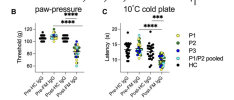
We have demonstrated for the first time that mice treated with FM patient IgG are sensitive to innocuous mechanical stimuli. Importantly, this behavioural hyperresponsiveness in FM IgG mice was accompanied by a sensitization of fast conducting Aβ low threshold mechanoreceptor (Aβ-LTMR) afferents. FM IgG administration additionally conferred an aberrant ‘cold’ sensitivity in a subset of Aβ-LTMRs and large diameter sensory neurons. Finally, we translated these findings back to people with FM and found altered firing of Aβ-LTMRs in response to cold and mechanical stimulation.
No animals were excluded from analysis. The experimenter was blinded to treatment, and mice were randomized to groups between cages.
Screenshot 2025-11-26 at 8.11.12 PM.png

I had wondered if the injection of human IgG was what was causing the mice to become more sensitive to stimuli that would normally not cause a reaction. But, they did have a control treatment of healthy human IgG. So, it does look as though the FM IgG did significantly change the sensitivity of the mice. They say the experimenter was blinded as to the treatments given to the mice, so that removes another possible issue.

The data presented here are pretty convincing that the FM IgG is not like that from the healthy controls. What would make these results invalid? Maybe some differences in how the IgG from FM and the healthy controls was prepared?

I forget, have we seen any other team try to produce anything like this using FM IgG? It wouldn't be a particularly hard experiment to replicate.
 
Last edited:
In the Introduction the authors also say:
In an independent assessment of 184 people with fibromyalgia, 68 patients had serum reactivity against targets in rat dorsal root ganglion and binding to NF200 positive neurons, a marker for large, myelinated afferents, was associated with the presence of paraesthesia in these patients.15
Ref 15 is Seefried S, Barcic A, Grijalva Yepez MF, et al. Autoantibodies in patients with fibromyalgia syndrome. Pain. 2025;166(8):1922-1933. That is a completely different team.

Forum thread for the study here.
 
From the Discussion:

Pressure sensitivity is an established hallmark of fibromyalgia, but other sensory abnormalities also feature prominently.2,32 Sensory symptoms other than pain, such as dysaesthesia and sensitivity to ambient temperature, are an often overlooked and important burden for those living with FM. Here, we provide evidence that autoantibodies contribute to the peripheral neurobiological basis of these symptoms.


We have previously demonstrated that administration of IgG from people living with FM to mice transfers hypersensitivity to noxious mechanical and cold stimuli, and here we show that autoantibodies might also be responsible for sensory abnormalities produced by innocuous tactile or cold stimulation of fast-conducting LTMRs. We show for the first time that IgG isolated from people with FM, who specifically described tactile and thermal sensory abnormalities, is sufficient to cause sensitivity to light touch in mice. Furthermore, cutaneous Aβ-LTMR in FM IgG injected mice were sensitized to both mechanical and cold stimulation.

This finding was further validated in vivo, by observing [Ca2+]i-responses in large diameter DRG neurons during cooling of the afferent terminals in the skin in mice treated with FM IgG. Our ex vivo studies of skin-nerve preparations from mice injected with human IgG strongly indicate that aberrant cold sensitivity of large diameter, fast-conducting AβSA fibres might at least in part be responsible for the cold and touch evoked sensitivity and paraesthesias/dysaesthesias reported by people with FM.

But they had a problem with their last experiment - I haven't got my head around this yet.
Finally, we translate our bench-side experimental findings back into humans by using questionnaires and microneurography to assess modality specific activity of AβSA afferents. AβSA fibres in people living with FM displayed reduced responses to the mechanical stimulation, but an increased proportion of these fibres responded to cooling.
Those particular nerves of people with fibromyalgia seemed to be less reactive rather than more reactive in response to mechanical stimulation.


The discussion is interesting and worth a read. We've been skeptical about the passive transfer ideas and perhaps we should still be. But there seem to be a few studies now more or less heading in the same direction. I've run out of steam to try to understand the paper better tonight.
 
Does this squash the central sensitisation explanation of chronic widespread pain beloved of psychobehaviourists?
I recall seeing one of the studies with the passive transfer tag that I looked at in passing earlier this evening still managed to shoe-horn previous emotional trauma into their paper somehow. So, I suspect the psychobehaviouralists will manage to be resilient to any squashing for sometime yet.

The authors of this paper talk about IgG mediated mechanisms in Chronic Regional Pain Syndrome. It would be fantastic if it all pans out.
 
Does this squash the central sensitisation explanation of chronic widespread pain beloved of psychobehaviourists?
If the findings are robust it at least demonstrates peripheral over- and under-sensitivity to various stimuli, possibly making central sensitisation redundant.

It would also make it more challenging to label the central pain response as a false alarm, because the central reaction would be appropriate to the peripheral input.

Although I have no doubt they would just find a new way to justify their favourite interventions that they are convinced work.
 
These are interesting preliminary results if they hold up to validation. What catches my eye immediately is the small number of IgG samples used for the transfer experiments—up to 3 for FM and no n listed for HC that I could see, which makes me think it’s n=1.

The 3 FM patients were selected based on strong positive response to plasma exchange treatment, meaning that they chose participants with the most evidence of disease being antibody-mediated. It’s a valid choice to make if you have limited resources to do these experiments to begin with, but it does mean that these results are likely only representative of a specific subset of FM if they are valid.
 
Back
Top Bottom