‘There’s nothing wrong with you’: The making of disability through encounters in accessible parking spaces, 2025,Kubenz

Dolphin

Senior Member (Voting Rights)

Years of scapegoating rhetoric has led to ‘envy and resentment’ of those with blue badges, research finds​

By John Pring on 4th December 2025Category: Transport

Listen
Years of scapegoating rhetoric and politicians casting disabled people as “scroungers” have reinforced prejudices about the blue badge parking scheme and led to “envy and resentment” instead of equal access, according to a four-year research project.

Half-hearted implementation of the scheme has left disabled people who rely on it feeling worried, angry and frustrated, and like “second-class citizens”, because of the encounters they have had while trying to use their badges, the research concludes.

The research was carried out by Vera Kubenz, a disabled postgraduate researcher at the University of Birmingham, and herself a blue badge holder.

Continues at:

I believe I read somewhere that she did and use a random sample of blue badge holders so the sample may not be representative

 
Trend on Twitter:
Disabled UK Drivers Face Rising Abuse Over Blue Badge Parking
Last updated Dec 23

A University of Birmingham survey of over 300 Blue Badge holders found 67 percent experienced abuse in accessible spaces, with 32 percent threatened with violence and 6 percent physically attacked. Victims reported being shouted at, followed, and having keys grabbed, fueled by backlash against the Motability scheme where disability payments fund car leases—despite Blue Badges being issued separately for severe mobility issues, including invisible conditions. Recent government reforms target Motability costs, but advocates stress badges require rigorous checks and urge the public to leave enforcement to authorities amid limited fraud rates.
 
Kubenz, V. I. (2025). ‘There’s nothing wrong with you’: The making of disability through encounters in accessible parking spaces. Urban Studies, 0(0). https://doi.org/10.1177/00420980251342964

‘There’s nothing wrong with you’: The making of disability through encounters in accessible parking spaces​

Vera Isabella Kubenz https://orcid.org/0000-0002-0867-9260 v.i.kubenz@bham.ac.uk
https://doi.org/10.1177/00420980251342964
Contents

Abstract

This paper explores what constitutes an ‘accessible’ space by examining encounters in accessible parking spaces during which disabled people are accused of ‘faking’ by strangers.

Parking and encounters are both quintessential urban phenomena, yet there is little research on how interpersonal interactions shape disabled people’s experiences of accessible spaces.

Focussing on Blue Badge parking in England, I situate my analysis in the context of negative public attitudes towards disabled people, after over a decade of stigmatisation under austerity politics.

I draw on a survey of 304 Blue Badge holders, presenting both quantitative and qualitative data.

I analyse how ‘faking’ encounters differ for disabled people by demographics and impairments, the factors participants feel contribute to encounters, and the encounters’ impact.

I then discuss how encounters contribute to everyday discrimination for disabled people and consider how (in)visibility and incongruence shape whether a space is ‘accessible’ in practice.
 

The Politics of Parking (Summary Report)​

  • Nov 29, 2023


HAD previously shared a survey on our social media platforms to gain the opinion of disabled drivers and passengers, regarding interactions that they have had with other members of the public.


The report goes in-depth about the positive and negative interactions disabled people have had whilst driving or being driven.


The author of the report, Vera Kubenz, who is a Postgraduate Researcher from the University of Birmingham, has had the courtesy to send us the finished version which can be read in full here.


The Politics of Parking survey summary report.pdf
Download PDF • 566KB


"Background


304 respondents completed the survey between 1 January and 30 June 2023. Participants had a Blue Badge for 12 years on average (ranging from 1 to 55 years). 67% of participants were women. People aged between 40-59 made up almost half of the sample. LGBA (22%) and transgender (8%) were overrepresented in the survey, and Black and Minority Ethnic people were underrepresented (6%). Most participants had mobility impairments (81%) and/or chronic illness (76%), and most had more than one impairment type (74%). 44% had an always visible impairment, 39% a sometimes visible impairment.


Types of encounters

Being accused of faking and confronting non-Blue Badge holders abusing bays emerged as the two main types of encounters. Faking accusations were experienced by young people, never or sometimes visible impairments, women, and were more common in South England. Faking accusations range from direct accusations and demands to inspect Badge, to surveillance, and passive-aggressive disapproval (tutting, staring). People with chronic illness also experienced more harassment. People over 60 were more likely to confront those abusing Blue Badge bays."
 
You are here: Home / Transport / Disabled people with blue badges ‘threatened, insulted and attacked’, survey shows
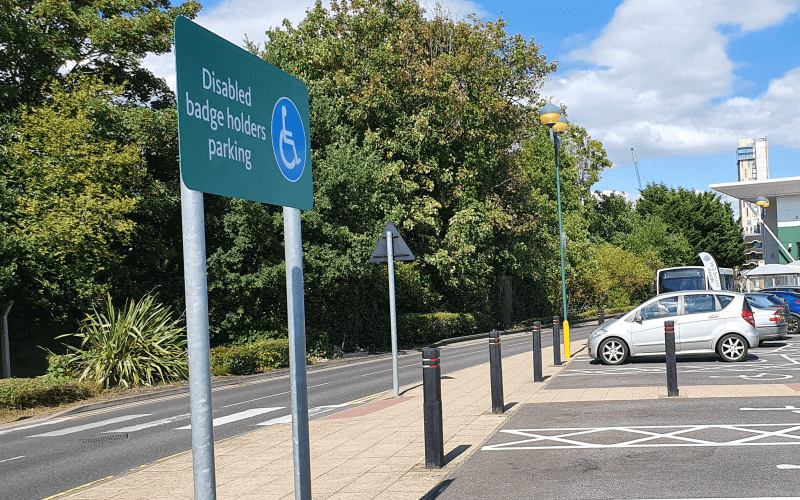
Sign for disabled badge holders' parking in supermarket carpark

Disabled people with blue badges ‘threatened, insulted and attacked’, survey shows​

By John Pring on 11th January 2024Category: Transport

Listen
Disabled people with blue parking badges in England are frequently being threatened, insulted, followed and even attacked as part of a “never-ending ordeal”, new research has revealed.
 
Ultimately the rhetoric has endangered disabled peoples lives, attacks are well up. Not just blue badge but its impacted on motability and they are coming for PIP and other benefits as well and that seems to be the goal to drastically cut spend on the disabled especially if it keeps climbing due to Long Covid as their projections suggest it will. They have spent a lot of their time focussing on mental health diagnoses and claiming minor conditions are leading to people getting BMWs and blue badge parking as if its some luxury lifestyle anyone can get. The reality is its enforced poverty and independence payments that don't even come close to covering the additional costs of being disabled.
 
I qualify for a disabled parking permit, but have not taken it up for exactly these reasons. Not going to add another layer of abuse to what I already have to deal with.

In a practical sense it doesn't make much difference, for various reasons. But there are occasions when I could benefit from it.

So, big thanks for that extra bit of nastiness for us to deal with, psychobabblers.
 
Last edited:
This is such an odd counterpart to wealth privilege, which is all about gaining access to exclusive things that the general public doesn't have access to. All it takes is to be born in the right family, or some random chance event, and no one will bat an eye, but extending accommodations, which are seen as privileges since they are exclusionary to the general public, is seen with disdain, even hostility.

Meanwhile if you're rich you always pay less than the general public for most things, while the poorest and most vulnerable have to pay many invisible taxes, from disabled people having to pay more while having no income, to poor people lacking the budget and space to buy in bulk.

We make life easier for those who don't need any help, in fact live in immense privilege, and harder for those who need help and support. Our priorities as a people are so backwards. No wonder people are so unhappy, and most of this is entirely organic, it barely needs any enforcement, some people will just do it for inexplicable reasons.

Humans are so freaking weird.
 
Back
Top Bottom