‘I Want Everyone to Have It, and Everyone to Be on It’: A Feasibility Study of the Transforming Long Covid Intervention, 2026, Belton et al

This here is of course made worse by the manipulative aspect, where people will obviously exclaim themselves to be better than they actually feel. It should have a far higher burden of evidence for this alone, and yet it doesn't do any better than any random bunch of supplements.
Since early in the covidlonghaulers sub creation I have been using Reddit Editor Suite to "tag" every person who makes a recovery story post simply as "recovered". There are an awful lot of recovered people still talking about their symptoms on that sub but many of them also still claim to be recovered in other peoples recovery posts, its a very odd combination of things to be doing IMO.
 
A further ethical question to consider is whether or not to control an evaluation trial with this population, a conundrum that is not new to such research [42], with the need to weigh and balance competing ethical objectives of trial design for each trial independently being well understood [43]. A carefully controlled trial brings important validity to study findings.
To control or not to control? Yes, control. Don't assume your intervention is so effective that it would be unethical not to offer it before it has been demonstrated to be effective in a carefully controlled trial.

A self-controlled design, however, such as that used by Donnino [5], may be most appropriate for a study population such as this, where symptoms have persisted for a significant period of time prior to the study (range: 26–59 months) and therefore ‘would be unlikely to experience a marked improvement in symptoms in a short period of time without intervention’ [5, p. 344].
I've looked at Donnino 2023 and cannot see any sign of an attempt to use patients as their own controls. This shows a lack of understanding of the degree of natural change in ME/CFS (see Rekeland et al. 2022) and upward drift in trial control groups' scores over time in ME/CFS (many reasons, spontaneous change, various biases), which are likely to also apply to those whose LC is ME/CFS.

While a self-controlled design [44] may overcome ethical challenges faced, such as withholding a treatment from those that may need it [42] or placing a burden on control participants [10], it requires a very careful consideration of study design and analysis.
The ethical challenge here is not to treat people with something ineffective or harmful, and not to miseducate people. So first, establish whether what you're doing is effective.
 
Since early in the covidlonghaulers sub creation I have been using Reddit Editor Suite to "tag" every person who makes a recovery story post simply as "recovered". There are an awful lot of recovered people still talking about their symptoms on that sub but many of them also still claim to be recovered in other peoples recovery posts, its a very odd combination of things to be doing IMO.
The scale readjustment of being ill for months at a time is enough to have people frame barely hanging on in a reduced life as being recovered. And it's perfectly understandable. It's like the first day after a bad acute illness that feels okayish. It's such an escape, even though if the direction went the opposite way, if someone went from their normal healthy self down to this state, the same people would frame this as a really worrying drop in their ability to function.

None of this is taken into account in anything health care professionals do because of how badly psychobehavioral ideology has distorted what they perceive. They can't work with reality because the models they use reject it. It's so easy and automatic to dismiss everything that matters and focus on trivial nonsense.
 
I've looked at Donnino 2023 and cannot see any sign of an attempt to use patients as their own controls. This shows a lack of understanding of the degree of natural change in ME/CFS (see Rekeland et al. 2022) and upward drift in trial control groups' scores over time in ME/CFS (many reasons, spontaneous change, various biases), which are likely to also apply to those whose LC is ME/CFS.
Oh I think they absolutely do understand that they get free wins by doing nothing and are exploiting the hell out of it. But that's only because it's obvious and always the case and this entire ideology is fundamentally dishonest.

The simple fact that an abundance of studies showing natural courses has never moderated anyone from claiming that a small but insignificant positive blip, which is obviously mostly bias, is promising despite being generally lower than what we see occur naturally is the big tell.

To make it clear: I am saying that everyone involved in this industry is aware of this, but find nothing wrong with it simply because they don't believe there is an illness in the first place anyway. They have an "ends justify the means" approach where pseudoscience is acceptable for pseudoillness, even though the pseudo nature of the illness is itself justified by pseudoscience. They are all aware that what they are doing is unethical, they just think it can be exempted because their beliefs, and a dysfunctional culture that rewards fake achievements, make it all feel justified.

This is why lying, in fact even the simple lack of candor, should be unacceptable in health care. It's way too easy to lock in failure and justify lies with more lies when those lies are popular.
 
I am saying that everyone involved in this industry is aware of this
I think some know exactly what they're doing. I don't think Sarajane Belton is deliberately misleading people.

I think the narrative that you managed to get yourself out of a horrible situation when doctors had failed, and now you're going to help others, is a powerful one. I think it's understandable that a narrative like that would be what a Professor of Physical Education would jump to to make sense of what they've been through. But a Professor of Physical Education also has a duty to be more scientific about things. It can be hard to be objective about your own experience. But if you're going to "treat" others, you've got to get rigorous. The section on controls suggests she really doesn't know what the issues are yet. She's got plenty of company.
 
I think some know exactly what they're doing. I don't think Sarajane Belton is deliberately misleading people.
There are so many red flags she would have to ignore that it’s difficult to put it down to pure incompetence.

We know from the cancer research that was funded by the tobacco industry that the people involved knew that you had to get the «right» results.

It’s an open secret that if you want to work in marine biology in Norway, you can’t speak negatively about farming salmon or other fish.

If you want to get anywhere within the public health sector, you can’t disagree publicly with the National Institute of Public Health (FHI), the home of Larun, Flottorp et al.

Ignoring your better judgement for other reasons is the norm. Even if it’s just to not ask uncomfortable questions, to keep yourself in the dark. It’s doublethink.
 
We know from the cancer research that was funded by the tobacco industry that the people involved knew that you had to get the «right» results.

It’s an open secret that if you want to work in marine biology in Norway, you can’t speak negatively about farming salmon or other fish.

If you want to get anywhere within the public health sector, you can’t disagree publicly with the National Institute of Public Health (FHI), the home of Larun, Flottorp et al.
In those examples, people all "know" and just have to play the game to have a career. That seems totally different from what is going on here.

I don't think the assumption of competence is a safe one.

Editing to add: I think the vast majority of those working in the health service would strugggle to identify the problems with trials of behavioural treatments in ME/CFS.
 
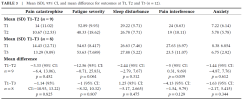
While only 5 participants filled out questionnaires at all 3 timepoints, this pattern looks a lot like what happens in ME/CFS trials with similar design, short-term bumps in how people respond to questionnaires that disappear over time:

Between baseline T1 and the end of treatment T2/wk 8, one or two outcomes look a little better (here pain interference and fatigue), but for those with data at T3, nothing approaches significance.


1778005646569.png

And why not just measure pain on the VAS? The two measures chosen reflect how someone is coping with pain, but if this intervention is so effective, shouldn't it reduce the pain itself?
 
Editing to add: I think the vast majority of those working in the health service would strugggle to identify the problems with trials of behavioural treatments in ME/CFS.
Not even the lack of blinding?

I can understand not understanding the nuances of p-hacking, multiple comparisons, MCIDs, deviations from protocols, correcting for confounders, and so on. Even identifying (ir)relevant outcomes. The education is very poor when it comes to scientific methodology.

But if they don’t understand the issue with not blinding the participants, they have virtually zero understanding of what a controlled trial is.

And if they don’t understand that anecdotes can’t be used to infer causal relationships, it’s even worse. Do they even know what correlation and causation means?
 
Not even the lack of blinding?
I think they're very aware of the need for blinding where that's possible, and then there's
  • a complete blindspot about the consequences of not blinding where that's not possible, i.e. in trials of behavioural treatments
  • not enough appreciation of what could affect scores on scales measuring fatigue/pain/etc outside of genuine change
  • trust that adverse effects would have been picked up in trials so things like exercise and CBT are safe
So people who would never dream of setting up an unblinded drug trial are happy to refer their patients for therapies whose only evidence base is unblinded trials.

There's no rational explanation for interpreting one/their own anecdote in one way and not considering alternative explanations, but health professionals are people too, and sometimes/often they react as humans rather than as professionals. And sometimes/often they just don't understand what they should understand, and they're surrounded by people who also don't understand (and maybe some who do but have no incentive to explain it to others), so they don't know that they don't know.
 
Last edited:
I think anyone designing a trial for ME/CFS needs to read Wechsler et al. 2011 Active Albuterol or Placebo, Sham Acupuncture, or No Intervention in Asthma, and then demonstrate how their outcome measures will get past that problem. (Thanks to @Joan Crawford for bringing that paper to my attention.) The basic problem with all the behavioural research needs to be taught, because people are not getting it on their own.

As @rvallee pointed out above, there are those who would read that and go, super, fatigue is subjective so all I need to do is give a placebo or sham and stick to subjective outcome measures. Or if I'm doing a controlled trial, compare my intervention with a no-intervention control, or an active control that is obviously shammier than the sham. Like say, Adaptive Pacing Therapy.
 
The journal this is published in:

Health Expectations is an open access health and social care journal publishing new research and articles that promote critical thinking and informed debate about all aspects of patient and public involvement and engagement (PPIE) in health and social care, policy and practice, health and social care research and education of health and social care professionals.
Editor Carolyn Chew-Graham

SPECIAL ISSUE Long Covid: Lived Experiences, Diagnosis, Treatment, and Care
June 2026
 
I've looked up the lead author, Dr Sarahjane Belton. She is not a clinician. She trained as a PE teacher and then did a PhD in physical activity and health. She is now an associate professor of PE at a Dublin university.

From her university biography:
https://www.dcu.ie/shhp/people/sarahjane-belton

Sarahjane graduated with a degree in Physical Education and Mathematics from the University of Limerick in 2001. After a year teaching physical education at second level, she completed her PhD in Physical Activity and Health at the University of Limerick in 2006. She lectured in Physical Education at St Patrick’s College, Drumcondra (2006–2007) before joining the School of Health and Human Performance at Dublin City University in 2007.

Research interests​

Key Research Interests: Physical and Health literacy in adolescents; Rehabilitation programmes for chronic illness; Intervention development and evaluation

Sarahjane is an Associate Professor of Physical Education at the School of Health and Human Performance at DCU. Sarahjane researches in the field of childhood physical activity and health, encompassing all related aspects from physical activity and fitness, motivation and attitudes, to fundamental movement skill abilities. Much of her work centres on developing and evaluating physical literacy and health literacy intervention programmes, from pre-school level up to post primary. She lead on, and been involved in, the development, evaluation and dissemination of many national youth school based physical and health literacy interventions including Y-PATH (Youth-Physical Activity Towards Health), Moving Well Being Well, Kids Active, and LifeLab, has collaborated with many national agencies in this endeavour, and has published numerous text books and papers in this field.

Sarahjane is also interested in the role of autonomic dysfunction in a range of chronic illnesses, and the development of rehabilitation intervention programmes targeting recovery from the perspective of autonomic function.
 
I note out of the 12 participants all reported fatigue, only 5 reported PEM.
And they were recruited from an exercise rehab programme:

TLC was delivered in a personal voluntary capacity by the lead author in partnership with ExWell Medical, a national community‐based chronic illness exercise rehabilitation programme. Participants were recruited through existing ExWell mailing lists (see Supplementary Material and Figure 1). An introductory email/text was sent to all ExWell participants explaining the programme and seeking expressions of interest.
 
Having looked at the ExWell site, it would be wildly inappropriate for most with ME/CFS. I would not have been able to participate at any severity.

It is exercise prescription. A health professional refers you and then you attend exercise classes at community centres or do online classes.
A standard class takes the form of a gradual warm-up, aerobic activity, strength training, core and balance exercises, and a cool-down section at the end.

All our centres cater to participants who would prefer to remain seated throughout.

There's a booklet about how to exercise at home. I thought I'd have a look to see if any of it would be possible for someone housebound. Eh, no.

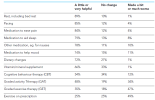
Here's how exercise prescription compared to GET and other delights in a 2014 Action for ME survey (see last two rows):

1778076579404.png
 
Last edited:
It is exercise prescription. A health professional refers you and then you attend exercise classes at community centres or do online classes.
Yeah that's definitely the problem, people just don't know how to exercise. It's just a total mystery to most people, can never figure out if it's left foot right foot left foot right foot, or some other difficult combination. Not that they are any great, but it's for this reason that basic education has physical education classes. And even then none of this is hard, no one exerts more energy than children playing.

That's one thing they never grasp, how insulting and disrespectful it is to be treated like a dumb child trying to put pants on our heads. Their models are premised on us being so inept we can't handle doing basic, normal things, and they can never grasp how insulting it is to be treated afterwards as if 'we' failed their ridiculous program because we're too dumb to figure any of this out.
 
Back
Top Bottom