The causal status of pain catastrophizing: an experimental test with healthy participants, 2005, Severeijns et al

Utsikt

Senior Member (Voting Rights)
The causal status of pain catastrophizing: an experimental test with healthy participants

Severeijns, Rudy; van den Hout, Marcel A.; Vlaeyen, Johan W.S.

Abstract
In the current study we report findings on the effects of experimentally induced catastrophizing about pain on expected pain, experienced pain and escape/avoidance behavior during a cold pressor task in a sample of healthy participants.

It was hypothesized that increasing the level of catastrophizing would result in a higher level of expected pain, a higher level of experienced pain, and a shorter duration of ice‐water immersion. Also, it was hypothesized that these relations might be stronger for participants who already catastrophized about pain prior to the experiment.

The results demonstrated that despite the successful attempt to induce catastrophizing, this neither significantly affected expected pain, experienced pain, and duration of ice‐water immersion, nor were these relations moderated by the pre‐experimental level of catastrophizing.

Although the level of catastrophizing was successfully manipulated, more similar experiments are necessary in order to give a more definite answer on the possible causal status of pain catastrophizing.

Web | DOI | European Journal of Pain
 
Nice find.

People in the experimental group were given the following info:
However, before we continue, we must inform you that a few people who have participated in the experiment have fainted during the ice–water immersion as they experienced sharp and cutting pain sensations. During the half an hour brake a psychologist closely inspected the questionnaires you completed at your arrival and this has revealed that your answers to the items of the questionnaires very closely resemble the answers of these people.
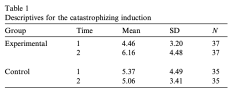
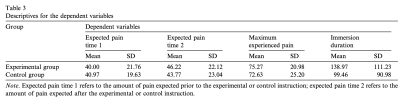
Their catastrophizing score increased but their pain rating and time in the cold water didn't.

1770402514480.png
1770402539177.png

They tried to induce negative affect in the control group but that didn't work. As a potential explanation they argue that temporary catastrophizing may be different from trait catastrophizing and that perhaps only the latter influence pain experience.
 
There is a long tradition in medicine of pseudo-signs and pseudo-diseases. We have pseudo-tumours, pseudo-hermaphroditism, pseudo-cysts, pseudopregnancy, pseudohypertrophy and, most beloved of geeky students, pseudohypoparathyroidism and pseudo-pseudohypoparathyroidism.

My impression is that they would be studying pseudocatastrophisation in normal people (like being told to play Lady MacBeth at questionnaire time) or even pseudo-pseudocatastrophisation*.

It is also my impression that psychologists don't appear to understand why this will inevitably be so.


* There being no such thing as actual catastrophisation,
 
They tried to induce negative affect in the control group but that didn't work.
This is how they tried to do it:
For participants in the control group the instructions continued: before we continue we must inform you that during the half an hour brake a psychologist closely inspected the questionnaires you completed at your arrival and this has revealed some disturbing information concerning your psychological stability and emotional competence. We therefore would like to ask you to stay after the experiment to talk with a psychologist about the possible action to take.
They also hid this gem outside the abstract: the catastrophizers held their hand in the ice-water for longer!
The effect with respect to the duration of ice–water immersion (t(70) = 1.64; p = 0.05, one-tailed) was significant but in the opposite direction of what was expected.
They try to claim that maybe the study was underpowered due to the large standard deviations for repeated ice water tests, even though they made a point out of how they met the recruitment target based on the initial power calculation.
 
For participants in the control group the instructions continued: before we continue we must inform you that during the half an hour brake a psychologist closely inspected the questionnaires you completed at your arrival and this has revealed some disturbing information concerning your psychological stability and emotional competence.

This sounds deeply unethical.
 
My expectation of FM pain? I have it while awake in various degrees, so there is no expectation. Just relief when levels are low. No relation of "expectation of pain" to "intensity of pain."

FM pain is a complex unknown involving at least the brain and nerves and the "pain catastrophizing" concept is very reductive.

I think the psychs are looking to offload the problem of people with chronic pain avoiding certain activities that are known to individual patients to worsen their pain to "pain catastrophizing" as a cause for inactivity.

The psychs believe you just have pain-lite and can assume most all normal activity.
 
This sounds deeply unethical.
The other one isn’t much better:
For participants in the experimental group, the instructions continued:
However, before we continue, we must inform you that a few people who have participated in the experiment have fainted during the ice–water immersion as they experienced sharp and cutting pain sensations. During the half an hour brake a psychologist closely inspected the questionnaires you completed at your arrival and this has revealed that your answers to the items of the questionnaires very closely resemble the answers of these people.
 
Back
Top Bottom