The association between hair cortisol levels, Epstein-Barr virus infections and chronic fatigue in adolescents, 2026, Kongsnes, Wyller et al

Dolphin

Senior Member (Voting Rights)

Research Article

The association between hair cortisol levels, Epstein-Barr virus infections and chronic fatigue in adolescents​

Berit Elise Bergem Kongsnes
,
Tarjei Tørre Asprusten
,
Vegard Bruun Bratholm Wyller
&
Maria Pedersen
Article: 2638303 | Received 20 Nov 2025, Accepted 23 Feb 2026, Published online: 02 Mar 2026

Abstract​

Chronic fatigue after Epstein-Barr virus (EBV) infection is a significant health problem among adolescents, yet its underlying mechanisms remain unclear.

This study investigated whether preinfection hair cortisol levels predict chronic fatigue following acute EBV infection and examined the associations between hair cortisol and concurrent fatigue during acute infection, six months postinfection, and in healthy controls.

This study is part of the CEBA project (Chronic Fatigue following Acute Epstein–Barr Virus Infection in Adolescents).

Hair samples for cortisol measurements were obtained from 192 adolescents aged 12–20 years during acute EBV infection and again six months later, and from 66 age- and sex-matched healthy controls.

Fatigue was measured by the total score on the Chalder Fatigue Questionnaire.

Group comparisons were performed using nonparametric tests, and associations were examined with linear regression analyses.

Adolescents with EBV infection had significantly higher preinfection hair cortisol levels (median 5.12, IQR: 3.27–8.76) compared with healthy controls did (median 3.90, IQR: 2.61–6.19) and with their own levels six months later (median 3.74, IQR: 2.46–6.52).

A trend toward a positive association between preinfection hair cortisol and fatigue during acute infection, became significantly negative six months later.

No associations were found among controls.

Preinfection hair cortisol concentration did not predict chronic fatigue six months after acute EBV infection.

Elevated preinfection hair cortisol may reflect stress-related vulnerability to infection, and the shifted from a positive to a negative association over time, suggests that HPA-axis alterations are more likely a consequence rather than a cause of chronic fatigue.

Keywords:

 
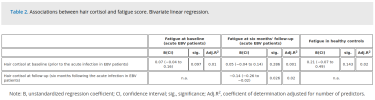
However, elevated hair cortisol levels prior to EBV infection were not associated with an increased risk of developing chronic fatigue (see Table 2). This is, to some extent, surprising, as the bio-psycho-social model of chronic fatigue suggests that stressors may lead to allostatic overload and persistent symptoms (Engel, Citation1997; McEwen, Citation2004).

Given previous findings indicating that patients with postinfective fatigue show signs of chronic stress, it would be intuitive to assume that such stress precedes and contributes to the development of fatigue (Pedersen et al., Citation2019; Sandler et al., Citation2021).

Nevertheless, our results align with observations from other infections; for example, Kalfas et al. found no association between preinfective hair cortisone concentrations and postinfectious fatigue following COVID-19 (Kalfas et al., Citation2024).
 
However, the level of cortisol six months after the acute EBV infection was negatively associated with the level of fatigue measured at the same time (Table 2).
this finding strongly suggests a shift in cortisol regulation as fatigue becomes chronic.

For the association they did find (higher fatigue at follow-up correlates to lower hair cortisol at follow-up) the correlation looks to be fairly small (R²=0.02). Unadjusted p=0.026.

1772893408759.png
 
Last edited:
The mindless idea that cortisol=stress as defined in the biopsychosocial model is ridiculous. Why is nonsense like this taken seriously? This is medieval alchemy level of oversimplistic reasoning. Oh, I'm sorry, I meant intuition, because apparently they can go with that without being laughed out of rooms.

I have no idea what is going on with the quoted text in comment #2. It was expected that cortisol should be elevated, because the model demands, somehow absurdly framed as 'intuitive', but it's also not surprising given that it aligns with prior results which found no such thing.

Up isn't down, it's all directions at once. Spin the wheeeeeel!
 
Lower hair cortisol and diminished parasympathetic responsiveness may reflect a state of chronic stress, as postulated by the “sustained arousal” theory of chronic fatigue (Wyller et al., Citation2009). However, contrary to that theory, our findings suggest that symptomatic fatigue precedes these physiological changes rather than resulting directly from them. Thus, rather than sustained arousal or stress being the primary cause of fatigue (as the sustained arousal model and some biopsychosocial accounts propose), our data indicate that the development of fatigue and its associated symptoms may lead to subsequent sustained arousal/stress.

In case anyone were wondering: this data was collected in 2015 and 2016. I wonder why it took them so long to publish it?!

Edit: the clinical trials page says the trial was completed in mid 2017, and Wyller was in charge. This data directly contradicts his main hypothesis. He has received funding for numerous studies since 2017, citing his hypothesis.
 
Last edited:
When fatigue persists for more than three months for adolescents, it is classified as chronic (Jordan et al., 2006). The most severe form, chronic fatigue syndrome (CFS), is characterized by disabling fatigue without a clear cause, accompanied by symptoms like cognitive difficulties, sleep disturbances, pain and so forth (Fukuda et al., 1994; Institute of Medicine, 2015; Jason et al., 2006).
It's interesting that they seem to consider CFS as mainly severe fatigue, and don't mention PEM. I suppose it's included in "and so forth".

CFS affects approximately 1.46% of the global population and 0.4%–2.4% of adolescents (Lim et al., 2020).
The 1.46% seems to be based on the average prevalence of Fukuda CFS from the meta-analysis by Lim et al, which seems like a less reliable figure than the meta-analysis prevalence. The average prevalence gives equal weight to all studies no matter the sample size, while the meta-analysis takes sample size into account.
Lim 2000 said:
The majority of the prevalence data (34 of total 56 data) were based on the CDC-1994 definition in our study, which found a mean prevalence of 1.46% and a meta-analysis result of 0.89% (Tables 2 and 3).
I'm having trouble finding what the claim of 0.4%-2.4% prevalence in adolescents is based on.
 
Within the CEBA cohort, participants were also evaluated for heart rate variability at each assessment point. As previously reported, we observed a similar shift in the association between autonomic measures and the level of fatigue: no association was present at baseline, but at six months, measures indicative of reduced parasympathetic responsiveness to controlled breathing were associated with higher fatigue levels (Pedersen et al., 2019). Lower hair cortisol and diminished parasympathetic responsiveness may reflect a state of chronic stress, as postulated by the “sustained arousal” theory of chronic fatigue (Wyller et al., 2009).
I'm not sure about the association of [edit: "reduced parasympathetic responsiveness to controlled breathing] with fatigue in the same cohort, but might the association of lower hair cortisol with fatigue be better explained by lower physical activity in people who are fatigued?

Objectively assessed physical activity is associated with increased hair cortisol content in young adults (2013, Stress)
A regression analysis revealed that participants with higher VPA [vigorous physical activity] had elevated hair cortisol concentrations even after taking into account age, gender and perceived stress (β = 0.33, p < 0.05, ΔR2 = 0.106).
 
Last edited:
Back
Top Bottom