Dolphin
Senior Member (Voting Rights)
Journal of Psychiatric Research
Available online 18 February 2026In Press, Journal Pre-proofWhat’s this?
Rates of likely neurodivergence and variant connective tissue in patients with chronic pain/chronic fatigue: a case-control study
Lisa Quadt a b c, Georgia Savage a, Rod Bond d, Kevin A. Davies a e, Hugo D. Critchley a b c, Jessica A. Eccles a b c
https://doi.org/10.1016/j.jpsychires.2026.02.036Get rights and content
Highlights
- •
Chronic pain/fatigue patients were 14 times more likely to meet criteria for autism - •
Chronic pain/fatigue patients were 13 times more likely to meet criteria for ADHD - •
Variant connective tissue mediated this relationship - •
This reveals a trans-diagnostic pattern of major clinical importance
Abstract
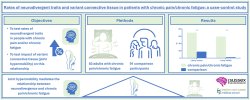
Neurodivergent traits are frequently observed in individuals with chronic pain and/or chronic fatigue (CP/CF), yet the underlying mechanisms remain unclear.This study investigated the prevalence of likely autism and ADHD in patients with CP/CF and examined whether joint hypermobility—a marker of variant connective tissue—mediated this relationship.
We conducted a case-control study using an online survey. Eighty-three adults with CP/CF and 91 adults from a non-clinical comparison group completed validated screening measures for autism, ADHD, and joint hypermobility.
Odds ratios (ORs) and 95% confidence intervals (CIs) for likely neurodivergence were calculated using binary logistic regression.
Mediation analysis tested whether joint hypermobility explained the association between likely neurodivergence and CP/CF. Participants with CP/CF had markedly higher odds of likely autism (adjusted OR 14.3 95% CI [6.5, 31.5]) and likely ADHD (adjusted OR 12.9 95% CI [5.0, 26.7]) than the comparison group.
The presence of joint hypermobility significantly mediated the relationship between neurodivergent traits and CP/CF (indirect effect: b=1.6 95% CI [1.2, 2.1]).
Our findings reveal a trans-diagnostic pattern of major clinical importance.
In patients with CP/CF, routine screening for neurodivergence should be considered to optimise fair access to appropriate support for improved quality of life.