jnmaciuch
Senior Member (Voting Rights)
Mitochondria-localised ZNFX1 functions as a dsRNA sensor to initiate antiviral responses through MAVS
Abstract
In the past two decades, emerging studies have suggested that DExD/H box helicases belonging to helicase superfamily 2 (SF2) play essential roles in antiviral innate immunity. However, the antiviral functions of helicase SF1, which shares a conserved helicase core with SF2, are little understood. Here we demonstrate that zinc finger NFX1-type containing 1 (ZNFX1), a helicase SF1, is an interferon (IFN)-stimulated, mitochondrial-localised dsRNA sensor that specifically restricts the replication of RNA viruses. Upon virus infection, ZNFX1 immediately recognizes viral RNA through its Armadillo-type fold and P-loop domain and then interacts with mitochondrial antiviral signalling protein to initiate the type I IFN response without depending on retinoic acid-inducible gene I-like receptors (RLRs). In short, as is the case with interferon-stimulated genes (ISGs) alone, ZNFX1 can induce IFN and ISG expression at an early stage of RNA virus infection to form a positively regulated loop of the well-known RLR signalling. This provides another layer of understanding of the complexity of antiviral immunity.
Web | DOI | PDF | Nature Cell Biology
Wang, Yao; Yuan, Shaochun; Jia, Xin; Ge, Yong; Ling, Tao; Nie, Meng; Lan, Xihong; Chen, Shangwu; Xu, Anlong
Abstract
In the past two decades, emerging studies have suggested that DExD/H box helicases belonging to helicase superfamily 2 (SF2) play essential roles in antiviral innate immunity. However, the antiviral functions of helicase SF1, which shares a conserved helicase core with SF2, are little understood. Here we demonstrate that zinc finger NFX1-type containing 1 (ZNFX1), a helicase SF1, is an interferon (IFN)-stimulated, mitochondrial-localised dsRNA sensor that specifically restricts the replication of RNA viruses. Upon virus infection, ZNFX1 immediately recognizes viral RNA through its Armadillo-type fold and P-loop domain and then interacts with mitochondrial antiviral signalling protein to initiate the type I IFN response without depending on retinoic acid-inducible gene I-like receptors (RLRs). In short, as is the case with interferon-stimulated genes (ISGs) alone, ZNFX1 can induce IFN and ISG expression at an early stage of RNA virus infection to form a positively regulated loop of the well-known RLR signalling. This provides another layer of understanding of the complexity of antiviral immunity.
Web | DOI | PDF | Nature Cell Biology

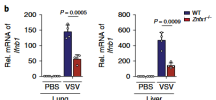

 I am trying to be mindful of just always seeing connections to the thing I'm interested in whether it's real or not, but as far as hypotheses go this is the best one could hope for in terms of something strongly hinted at by the genetics data. I should note that TRIM38, another tier 1 candidate gene, directly prevents the degradation of cGAS (cGAS is basically the DNA-sensing cousin to ZNFX1/RIG-I/MDA5).