Long COVID Prevalence and Risk Factors: A Systematic Review and Meta-Analysis of Prospective Cohort Studies
[Line breaks added]
Background: Long COVID, or post-acute sequelae of SARS-CoV-2 infection (PASC), affects millions globally, with persistent symptoms impacting quality of life. This meta-analysis synthesizes prospective cohort studies to estimate the prevalence of Long COVID symptoms and identify risk factors.
Methods: We systematically searched PubMed for prospective cohort studies (2020–2025) on Long COVID, focusing on prevalence and risk factors. Studies with ≥100 participants and follow-up ≥3 months were included. Data were extracted on symptom prevalence (e.g., fatigue, dyspnoea) and risk factors (e.g., sex, hospitalization). Random-effects models were used to pool prevalence and odds ratios (OR). Risk of bias was assessed using the Newcastle–Ottawa Scale (NOS).
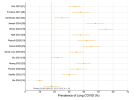
Results: Fourteen prospective studies (n = 168,679) were included. Pooled prevalence of Long COVID was 18.0% (95% CI: 12.5–23.5%, I2 = 9.8%) among survivors followed for ≥6 months.
Fatigue (41.0%, 95% CI: 33.2–49.4%) and dyspnoea (22.5%, 95% CI: 15.6–29.8%) were the most common symptoms. Female sex (OR = 1.52, 95% CI: 1.25–1.92) and prior hospitalization (OR = 2.35, 95% CI: 1.98–2.90) were significant risk factors. High heterogeneity (I2 > 90%) was noted.
Conclusions: Long COVID affects over one-fifth of SARS-CoV-2 survivors, with fatigue and dyspnoea persisting in many. Female sex and severe acute infection increase risk. Standardized definitions and longer follow-up are needed.
Web | DOI | PMC | PDF | Biomedicines | Open Access
Halas, Ramona-Georgiana; Berceanu Vaduva, Delia Mira; Radulescu, Matilda; Bredicean, Ana-Cristina; Mateescu, Diana-Maria; Toma, Ana-Olivia; Cotet, Ioana-Georgiana; Guse, Cristina-Elena; Marginean, Andrei; Margan, Madalin-Marius; Lazureanu, Voichita Elena
[Line breaks added]
Background: Long COVID, or post-acute sequelae of SARS-CoV-2 infection (PASC), affects millions globally, with persistent symptoms impacting quality of life. This meta-analysis synthesizes prospective cohort studies to estimate the prevalence of Long COVID symptoms and identify risk factors.
Methods: We systematically searched PubMed for prospective cohort studies (2020–2025) on Long COVID, focusing on prevalence and risk factors. Studies with ≥100 participants and follow-up ≥3 months were included. Data were extracted on symptom prevalence (e.g., fatigue, dyspnoea) and risk factors (e.g., sex, hospitalization). Random-effects models were used to pool prevalence and odds ratios (OR). Risk of bias was assessed using the Newcastle–Ottawa Scale (NOS).
Results: Fourteen prospective studies (n = 168,679) were included. Pooled prevalence of Long COVID was 18.0% (95% CI: 12.5–23.5%, I2 = 9.8%) among survivors followed for ≥6 months.
Fatigue (41.0%, 95% CI: 33.2–49.4%) and dyspnoea (22.5%, 95% CI: 15.6–29.8%) were the most common symptoms. Female sex (OR = 1.52, 95% CI: 1.25–1.92) and prior hospitalization (OR = 2.35, 95% CI: 1.98–2.90) were significant risk factors. High heterogeneity (I2 > 90%) was noted.
Conclusions: Long COVID affects over one-fifth of SARS-CoV-2 survivors, with fatigue and dyspnoea persisting in many. Female sex and severe acute infection increase risk. Standardized definitions and longer follow-up are needed.
Web | DOI | PMC | PDF | Biomedicines | Open Access