Intravenous immunoglobulin treatment for long COVID: a case report of clinical and immunological findings 2026 Camici et al

Jaybee00

Senior Member (Voting Rights)

Summary​

A previously healthy 39-year-old man developed highly symptomatic post-COVID-19 condition (also known as long COVID) marked by cognitive dysfunction, disabling fatigue, and autonomic symptoms unresponsive to multiple multidisciplinary interventions. Given the presence of markedly elevated serum autoantibodies against G protein-coupled receptors, high-dose intravenous immunoglobulin therapy was initiated at 400 mg/kg per day for 5 consecutive days.

After 4 weeks, a maintenance dose of 500 mg/kg was administered for 1 day, followed by two further maintenance cycles consisting of 500 mg/kg per day for 3 consecutive days, each given at 4-week intervals. In parallel, the patient underwent a cognitive stimulation intervention. Neurological symptoms were assessed with the Fatigue Assessment Scale and the WHO Disability Assessment Schedule 2.0, and the immunological profile was longitudinally analysed during intravenous immunoglobulin treatment.

Fatigue scores normalised, neurocognitive performance returned to normal value, and quality of life improved after the first infusion and fully recovered within 1 year. Immunological profiling revealed the presence of an inverted CD4 to CD8 T-cell ratio that persisted during the whole follow-up.

We also identified a CD8+ T cell–monocyte complex and spontaneous IFNγ release. Intravenous immunoglobulin therapy was associated with a significant reduction of these complexes, spontaneous IFNγ and TNF production, markers of endothelial inflammation, and circulating autoantibody titres.

This patient provides exploratory evidence that high-dose intravenous immunoglobulin was associated with sustained clinical recovery from long COVID over 1 year of follow-up, accompanied by immunological changes consistent with modulation of post-viral immune dysregulation, including a reduction in pathogenic T cell–monocyte synapses.

Although causal inference cannot be established from a single patient, these findings suggest that this cellular interaction can contribute to long COVID and that immunomodulation could represent a rational therapeutic approach to be evaluated in selected patients.

 
Last edited by a moderator:
We report treatment of a patient with long COVID with initial daily intravenous immunoglobulin (500 mg/kg) for 5 days followed by a 1-day maintenance infusion of 500 mg/kg after a month, and two further maintenance infusions of 500 mg/kg per day for 3 consecutive days, each given at 4-week intervals supported by detailed immunological and neurocognitive characterisation with follow-up of approximately 12 months.

Intravenous immunoglobulin administration was associated with rapid clinical improvement, including resolution of fatigue and cognitive symptoms and recovery of functional status, alongside immunological changes consistent with restoration of immune homoeostasis. These changes included a reduction in aberrant CD8+ T cells–monocyte synapses associated with spontaneous IFNγ release and endothelial inflammation, offering a plausible biological context for the observed clinical response.

Evidence regarding the use of intravenous immunoglobulin therapy in adolescents and adults with myalgic encephalomyelitis/chronic fatigue syndrome (ME/CFS), a condition that substantially overlaps with long COVID, derives from four double-blind randomised controlled trials, the results of which are conflicting.

Although evidence remains scarce and comparative data are low quality, no comparable clinical responses were reported in a long COVID case series, in which patients received low-dose (500 mg/kg) intravenous immunoglobulin for more than 6 months, nor in ME/CFS studies using low-dose intravenous immunoglobulin. Together with the favourable outcome observed in this patient, these observations suggest, without establishing causality, that high-dose intravenous immunoglobulin (>1 g/kg) can be relevant to clinical response in some patients.

This finding warrants evaluation in controlled studies. Given that intravenous immunoglobulin consists predominantly of IgG, the infused antibodies could saturate Fcγ receptors on monocytes, thereby increasing their activation threshold and hindering the formation of stable immunological synapses with CD8+ T cells. This Fcγ receptor-mediated blockade could be a key mechanism through which intravenous immunoglobulin dampens chronic T cell–monocyte crosstalk in post-viral immune dysregulation.

High-dose intravenous immunoglobulin saturates the neonatal Fc receptor (FcRn), a key recycling receptor expressed by endothelial cells that extends IgG half-life; overwhelming this pathway accelerates the degradation of endogenous IgG, including pathogenic autoantibodies. Indeed, in the absence of FcRn, the half-life of IgG is dramatically shortened, effectively preventing the initiation and propagation of tissue inflammation.

Furthermore, sialylated IgG Fc fractions within intravenous immunoglobulin can upregulate the inhibitory FcγRIIb, shifting the immunoregulatory balance towards suppression, while concurrent saturation of activating Fcγ receptors diminishes their availability for immune-complex binding and downstream activation.
 
"Spontaneous IFN gamma release"?

It just means that circulating cells collected from the patient secrete detectable interferon-g even before something is added to the cells to stimulate that secretion

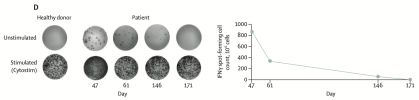
To investigate the functional consequences of the activated T-cell profile, we quantified the ex-vivo proinflammatory T-cell signature by performing IFNγ enzyme-linked immunosorbent spot (ELISpot) after T-cell receptor triggering with PBMCs collected at multiple timepoints (days 47, 61, 146, and 171) during intravenous immunoglobulin treatment.

As expected, PBMCs from healthy donors did not produce IFNγ in the absence of stimulation (figure 2). By contrast, the patient displayed a high frequency of spontaneously IFNγ secreting PBMCs, indicating active inflammatory cytokine production). Notably, the intravenous immunoglobulin treatment was associated with a reduction of the number of IFNγ spot-forming cells, eventually returning to background concentrations by the final timepoint (day 171). Although we recognise that controlled studies are needed to verify the cause–effect relationship of this observation, these data suggest that intravenous immunoglobulin can exert an immunomodulatory effect capable of suppressing aberrant IFNγ production.


Cytostim.png
 
Bit of OT:

In my local support group, two people have managed to get it covered by insurance. I think it’s completely absurd that it can be prescribed so easily without solid evidence, but apparently there are ways to get a diagnosis through the new ME/CFS outpatient clinic in vienna that justifies it.

The basis for this seems to have been these dubious antibody tests offered by labs like CellTrend or IMD Berlin.

They are now receiving immunoglobulins for a year, costing around €50,000. Both of them are rather mildly affected.
I’m curious to see how it turns out, I’ll definitely keep you updated if any kind of “miracle recovery” happens.
 
How long had they been sick? And why not do any of those tests before the treatment?
They were infected during the Omicron phase, around 2022. I reviewed the medical reports. The doctors referenced the following study: https://pubmed.ncbi.nlm.nih.gov/36818469/

Together with the positive autoantibody tests, this apparently was sufficient to obtain approval for the therapy.
 
Back
Top Bottom