FND Nope

Liie

Senior Member (Voting Rights)
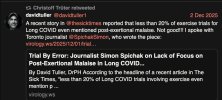
I happened to come across the following charmingly named site:


I don't see it mentioned on the forum previously.

Here are a few articles that seem relevant for the forum:


The page is run by a Christoff Truter who is a carer for a person who he believes has been misdiagnosed with FND.

(As usual I was too exited to find something the forum might be interested in to actually read the articles before posting them here... : P )
 
Last edited:
Great name.

Firstly, my personal acceptance or rejection is irrelevant. Diagnosis should not be influenced by feelings, but by measurable, testable, and replicable evidence. The idea that merely accepting the diagnosis, rather than the treatment itself, improves outcomes should already raise eyebrows.

That said, if all due diligence has been done, FND can serve as a useful construct, but only if we keep diagnostic doors open, avoid treating it as concrete, and remain honest about its subjective nature.

So, what would convince me? Instead of relying on non-specific fMRI results, which could reflect many other conditions, objective and measurable evidence is essential. Most importantly, the diagnosis itself must be falsifiable.

FND, being none of those, is therefore effectively a soft science, which I view warily because it relies on subjective interpretation rather than objective evidence, increasing the risk of misdiagnosis and missed treatable conditions.

FND is not a rule-in diagnosis as suggested, but rather a buy-in diagnosis.

It seems there is an inherent problem where many medical professionals are not able or willing to remain agnostic about uncertainty.

The danger is that this approach treads dangerously close to being religious in nature; even the DSM-5 narrative echoes the sentiment of faith healers.

Throughout my wife's medical journey, she was frequently patronised by doctors, from gastroenterologists diagnosing functional gastrointestinal issues while laughingly advising her to eat less cake during investigations of unexplained weight gain, to neurologists assuming functional neurological problems before even examining her.

Even psychologists attempted to probe her past, aiming to fit her neurological issues into their own narrative.

We ended up withholding information about her upbringing and childhood because we did not trust doctors to avoid latching onto something and prematurely closing diagnostic doors due to their psychologisation bias.

There was an attempt to reframe this form of psychologisation in the FND diagnosis. Instead of explicitly blaming psychological factors, clinicians now attribute it to a brain network issue. Nevertheless, many clinicians, especially psychiatrists, still adhere to the psychological explanation.

I’m a software developer from South Africa, not a doctor

I continue to delve deeply into the medical literature, hoping one day to contribute scientifically to improve her condition and that of others like her, particularly by shedding light on underlying conditions that are too often overlooked or misattributed. The irony isn’t lost on me: FND is often described as a 'brain software' problem, and as a software developer, I find myself searching for a ‘brain stack’ to debug.

Post on FND and the replication crisis
Post on A Tale of Four Neurologists

Comment on The Dark Truth Behind the 4% Misdiagnosis Rate in Functional Neurological Disorder

I agree wholeheartedly that this latest iteration of "hysteria" is highly dangerous to patient welfare, illogical, unscientific, and absolutely asinine! I also think it an utter disgrace that female doctors have attached their names to this diabolical garbage, calling it a "feminist issue", while applauding the stigmatization and disenfranchisement of said female patients whom they pretend to "protect".

(FYI @dave30th)
 
LMAO. I completely missed that it's FND Nope, and not FND Hope, and was wondering when the thing would turn into BS. I guess this is in response to the actual FND Hope.

The one time my cynicism radar was tuned too high. It actually happened, folks! Once!

I really love this line:
FND is not a rule-in diagnosis as suggested, but rather a buy-in diagnosis.
 
Love the line buy-in diagnosis rather than rule-in

It’s getting across what’s going on in a does what it says on the tib way.

Much needed to have someone with fresh eyes just saying it how they see it of what we have to weather and what bystanders are often happily buying into sophism wise.
 
Back
Top Bottom