John Mac
Senior Member (Voting Rights)
Abstract
Background: Chronic Fatigue Syndrome (CFS), also known as Myalgic Encephalomyelitis (ME), is a debilitating condition characterized by persistent fatigue and multisystemic symptoms, such as cognitive impairment, musculoskeletal pain, and post-exertional malaise. Recently, parallels have been drawn between ME/CFS and Long COVID, a post-viral syndrome following infection with SARS-CoV-2, which shares many clinical features with CFS. Both conditions involve chronic immune activation, raising questions about their immunopathological overlap.Objectives: This study aimed to compare immune biomarkers between patients with ME/CFS or Long COVID and healthy controls to explore shared immune dysfunction.
Methods: We analyzed lymphocyte subsets, cytokine profiles, psychological status and their correlations in 190 participants, 65 with CFS, 54 with Long COVID, and 70 healthy controls.
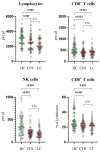
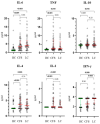
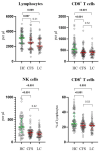
Results: When compared to healthy subjects, results in both conditions were marked by lower levels of lymphocytes (CFS—2.472 × 10⁹/L, p = 0.006, LC—2.051 × 10⁹/L, p = 0.009), CD8+ T cells (CFS—0.394 × 10⁹/L, p = 0.001, LC—0.404 × 10⁹/L, p = 0.001), and NK cells (CFS—0.205 × 10⁹/L, p = 0.001, LC—0.180 × 10⁹/L, p = 0.001), and higher levels of proinflammatory cytokines such as IL-6 (CFS—3.35 pg/mL, p = 0.050 LC—4.04 pg/mL, p = 0.001), TNF (CFS—2.64 pg/mL, p = 0.023, LC—2.50 pg/mL, p = 0.025), IL-4 (CFS—3.72 pg/mL, p = 0.041, LC—3.45 pg/mL, p = 0.048), and IL-10 (CFS—2.29 pg/mL, p = 0.039, LC—2.25 pg/mL, p = 0.018).
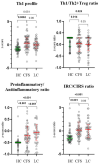
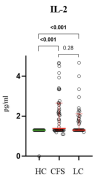
Conclusions: Notably, there were no significant differences between CFS and Long COVID patients in the tested biomarkers. These results demonstrate that ME/CFS and Long COVID display comparable immune and inflammatory profiles, with no significant biomarker differences observed between the two groups.