CD38 ligation plays a direct role in the induction of IL-1β, IL-6, and IL-10 secretion in resting human monocytes, 2002, Lande et al

jnmaciuch

Senior Member (Voting Rights)
CD38 ligation plays a direct role in the induction of IL-1β, IL-6, and IL-10 secretion in resting human monocytes

Lande, Roberto; Urbani, Francesca; Di Carlo, Beatrice; Sconocchia, Giuseppe; Deaglio, Silvia; Funaro, Ada; Malavasi, Fabio; Ausiello, Clara M.

Abstract

CD38 signaling, either induced by ligation with specific agonistic monoclonal antibody (mAb) or after interaction with CD31, its cognate counter-receptor, is involved in release of IL-1β, IL-6, and IL-10 cytokines in resting human monocytes. CD38 ligation by the F(ab′)2 IB4 mAb did not induce signals relevant for cytokine secretion and the block of the Fcγ receptor I (FcγRI) by anti-CD64 or FcγRII by anti-CD32 mAb did not inhibit CD38-mediated IL-1β release. Dimerization or multimerization of the CD38 molecule by: (i) cross-linking of the receptor ligated by F(ab′)2 or by (ii) increasing CD38 expression by treating monocytes with IFNγ were able to restore the truncated CD38-mediated signals involved in cytokine secretion. These data indicate that CD38 receptor-mediated signals operate directly suggesting a Fcγ receptorial surface molecule independent activation pathway. The key element for the receptor mediated signaling is represented by surface density of CD38 on resting monocytes.

Web | DOI | Cellular Immunology
 
Last edited:
Just had a thought about something I mentioned offhandedly a while ago in this discussion:


I posted a link to this paper showing that if you take NK cells and expose them to daratumumab, it actually has the effect of enhancing NK function:

I realized that I've been assuming any off-target effect of daratumumab would be through blocking CD38 activity. But there are actually several examples where mAbs stimulate receptors instead of blocking them--for example, T cells are commonly stimulated using antibodies targeting CD3 and CD28.

Since dara seems to stimulate NK cells and CD38 is expressed on lots of different cell types, I just wanted to see if there was prior research showing that anti-CD38 antibodies stimulate other immune cells and I found this. I'm particularly interested in cytokine release because of how they are known to counteract each other. The cytokines mentioned here are some of the main ones released by myeloid cells during infection. I thought it lined up well with some anecdotal reports of pwME getting relief from their symptoms in the first few days of an infection.

I guess I'm just curious if the few daratumumab responders also happen to feel better during viral infections.
 
Last edited:
1772653821995.png

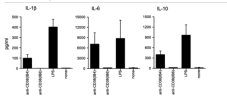
This is just fascinating to me because these results are with no priming, no other stimulation. It shows that an anti-CD38 antibody alone can induce a response that, for some of these cytokines, is comparable to bacterial infection (LPS is a fragment of a bacterial cell wall that induces a very strong response from this cell type)
 
I thought it lined up well with some anecdotal reports of pwME getting relief from their symptoms in the first few days of an infection.

There's this thread where the immune system is reportedly activated by a bacterial vaccination in order to improve ME/CFS, maybe something similar? (But I need to sit down with a cup of coffee and read this all again to follow it.)

 
I thought it lined up well with some anecdotal reports of pwME getting relief from their symptoms in the first few days of an infection.

I guess I'm just curious if the few daratumumab responders also happen to feel better during viral infections.

Very interesting question!!

Maybe the patients even felt like they got an infection when they started improving?

The only remission I ever had started with a fever and my back feeling so cold I had to lie on my back, because otherwise it felt like it would freeze to ice. And I basically never get proper fevers like that. Not since I was 18 or so.

I would really like to know if they have quizzed the responder patients in which order their symptoms improved too. Being able to breathe normally and feeling sleepy were the two first and significant signs for me. Especially because both came immediately a d out of nowhere. Literally woke up in the middle of the night just breathing through my nose.

Do we even know what % MECFS patients report feeling better during infections?
 
Last edited:
There's this thread where the immune system is reportedly activated by a bacterial vaccination in order to improve ME/CFS, maybe something similar? (But I need to sit down with a cup of coffee and read this all again to follow it.)

Thanks for the link, that's interesting! I will also have to spend some time going through it. If there is any merit to either treatment, I wonder if the difference between vaccination vs. daratumumab is both in the specific cytokines induced and the length of time they are induced for--bacterial fragments from a vaccine would be cleared out relatively quickly by the immune system whereas mAbs can hang around for a long time. If it is a matter of using one cytokine to cancel out the effects of another, both of those factors would matter a lot (esp if the counter-regulation is at an epigenetic level, which it seems to be in some cases like IL-10)

The only remission I ever had started with a fever and my back feeling so cold I had to lie on my back, because otherwise it felt like it would freeze to ice.
Interesting detail! Both fever and chills are strongly tied to prostaglandins during infection, which are triggered by IL-1B and IL-6 signaling in the hypothalamus.

Do we even know what % MECFS patients report feeling better during infections?
Not sure! I've only seen it mentioned anecdotally.
 
If you don't mind me asking, was the abnormal breathing due to congestion?

It's very difficult to describe. No one has ever found anything medically abnormal in me if that is what you are asking. I even had quite a few different tests done specifically to my nose and some breathing tests, all completely normal.

I've seen some MECFS patients refer to it as Phantom nasal congestion. Ive had it for so long that I even forgot it was a thing and haven't mentioned it to a doctor in over a decade. So it was something I immediately noticed when I woke up in the middle of the night just breathing normally and what felt extremely powerfully through my nose. Immediately knew something special was happening then. Because I couldn't recall breathing like that, ever.

Even when I was ''mild'' as a child it is one of the first weird things I remember about my early MECFS. Because I loved sports despite my creeping random fatigue but something always felt completely off about my breathing and I hated swimming and being under water because of it.

Hope I answered your question!!
 
Something I only recently got my head around is what CD38 is. Posting in case it helps others and to check my understanding if anyone wants to correct me!

I assumed a straight receptor. Then found it had dual (or multiple) roles but I was still thinking about it wrong. Now I may still be wrong but by understanding is it’s a cell surface protein and it can be utilised as an enzyme in certain processes (like creation of cADPR which is important for calcium signalling) or act as a receptor (like binding to CD31 on T cells which triggers cytokine production as mentioned here).

So when daratumumab acts upoon it, depending on what cell and what role it can have different effects. It may start a process which kills the cell, or it may reduce availability an enzyme the cell needs for calcium signalling, or, I guess other things?

And can’t IFN increase CD38 too?
 
It may start a process which kills the cell, or it may reduce availability an enzyme the cell needs for calcium signalling, or, I guess other things?
Yeah CD38 seems to have quite a few distinct functions. The in-vitro data I've seen suggests that CD38 doesn't do much to kill cells--cell death from daratumumab in cancer would be because the antibody tags plasma cells that express very high levels of CD38. Cells that are coated in antibodies like that are then targeted for cell killing by NKs (a similar process happens with bacteria).

What this thread's study and the lupus NK cell study I posted seem to show is that CD38 is also involved in cytokine production. I should note that it's not 100% clear that anti-CD38 antibodies activate CD38--that's a specific phrase having to do with a shape change in a receptor leading to a downstream cascade inside the cell. Instead, it might the case that an anti-CD38 antibody does actually block the activity of CD38, and the downstream effects of that are enough to trigger cytokine release. Either way, whatever daratumumab does to immune cells besides plasma cells, the end result is increased levels of certain cytokines.

And can’t IFN increase CD38 too?
Yes, CD38 transcription is stimulated by NFkB + STAT signaling
 
It's very difficult to describe. No one has ever found anything medically abnormal in me if that is what you are asking. I even had quite a few different tests done specifically to my nose and some breathing tests, all completely normal.

I've seen some MECFS patients refer to it as Phantom nasal congestion. Ive had it for so long that I even forgot it was a thing and haven't mentioned it to a doctor in over a decade. So it was something I immediately noticed when I woke up in the middle of the night just breathing normally and what felt extremely powerfully through my nose. Immediately knew something special was happening then. Because I couldn't recall breathing like that, ever.

Even when I was ''mild'' as a child it is one of the first weird things I remember about my early MECFS. Because I loved sports despite my creeping random fatigue but something always felt completely off about my breathing and I hated swimming and being under water because of it.

Hope I answered your question!!
Thanks! I was just asking about congestion because there have been some mouse studies that tie mucus production to a specific cytokine. What you describe is interesting and I’ll keep it in mind, thanks for sharing
 
I've seen some MECFS patients refer to it as Phantom nasal congestion. Ive had it for so long that I even forgot it was a thing and haven't mentioned it to a doctor in over a decade. So it was something I immediately noticed when I woke up in the middle of the night just breathing normally and what felt extremely powerfully through my nose. Immediately knew something special was happening then. Because I couldn't recall breathing like that, ever.

Even when I was ''mild'' as a child it is one of the first weird things I remember about my early MECFS. Because I loved sports despite my creeping random fatigue but something always felt completely off about my breathing and I hated swimming and being under water because of it.

Oh wow... core memory unlocked! While my onset occurred gradually over decades, it was clear that something was going wrong in my late-teens/early-twenties - it just took a very long time to become disabling. I had nearly completely forgotten, but right at the very start of this period there was a single that that I can vividly recall when something seemed quite suddenly off with my breathing, particularly in or near the nasopharynx. I noticed it while walking one day, just prior to departing on my first trip to Germany back in the 90s, and took it for a sign that I was coming down with a cold, to my immense frustration. The cold never arrived, but the altered breathing never left. Decades of tests turned up little - a minor allergy to dust mites, some slightly enlarged turbinates, a half dozen other dead ends - my breathing still feels "wrong." Sometimes it even seems as though my brain fog and generally deficient cognition is rather specifically inhibited by... something... in my sinuses or nasopharynx.
Huh.
 
Thanks! I was just asking about congestion because there have been some mouse studies that tie mucus production to a specific cytokine. What you describe is interesting and I’ll keep it in mind, thanks for sharing

That's very interesting!! Personally I've always had this small weird obsessesion with phlegm production / snot and MECFS, to the point that I actually wrote down in my notes that I produced a small hard ball of phlegm in those first days of improvement too. But mucus just hasn't been something I have seen many patients or scientists discuss or think about when it comes to MECFS, so interesting you brought it up!!
 
Last edited:
Back
Top Bottom