Babesia & Bartonella Species DNA in Blood & Enrichment Blood Cultures from...Chronic Fatigue & Concurrent Neurological Symptoms, 2025, Breitschwerdt

Dolphin

Senior Member (Voting Rights)

Open Access Article

Babesia and Bartonella Species DNA in Blood and Enrichment Blood Cultures from People with Chronic Fatigue and Concurrent Neurological Symptoms
by
Edward B. Breitschwerdt
*<i></i>,
Ricardo G. Maggi
<i></i>,
Janice C. Bush
<i></i> and
Emily Kingston
<i></i>


Intracellular Pathogens Research Laboratory, Comparative Medicine Institute, College of Veterinary Medicine, North Carolina State University, Raleigh, NC 27607, USA
*
Author to whom correspondence should be addressed.
Pathogens 2026, 15(1), 2; https://doi.org/10.3390/pathogens15010002
Submission received: 12 November 2025 / Revised: 11 December 2025 / Accepted: 17 December 2025 / Published: 19 December 2025

Abstract​

Myalgic encephalomyelitis/chronic fatigue syndrome (ME/CFS) is a medical condition characterized by extreme fatigue lasting at least 6 months.

Based upon case reports, patients infected with Babesia or Bartonella spp. have reported a history of chronic fatigue and concurrent neurological symptoms.

In this study, 50 study participants reporting fatigue lasting from six months to 19 years and one or more neurological symptoms were selected. PCR assays were used to amplify Babesia and Bartonella spp.

DNA from blood and enrichment blood cultures.

Using targeted qPCR amplification and DNA sequencing, infection with Babesia spp., Bartonella spp. or both genera was confirmed in 10, 11, and 2 individuals, respectively.

Of 50 participants, 12 (24%, 95% CI: 12–36%) were infected with a Babesia species, while Bartonella species infection was documented in 13/50 individuals (26%, 95% CI: 13.8–38.2%).

This study provides documentation supporting a potential role for Babesia and Bartonella infection in patients with presentations consistent with ME/CFS.

Prospective case–control studies, using highly sensitive direct pathogen detection techniques, are needed to determine whether or the extent to which infection with members of these two genera contributes to or causes ME/CFS.

Keywords:
Bartonella; Babesia; flea; tick; vector; infection; PCR; enrichment culture
 

Study Population​

Participants were selected from a cohort of 173 individuals who were previously tested for Bartonellaspp. infection as a component of an Institutional Review Board (IRB) approved study entitled: Detection of Bartonella Species in the Blood of People with Extensive Animal Contact (North Carolina State University Institutional Review Board, IRB# 1960).
Due to chronic illnesses of varying severity and duration, all participants or their physician had contacted the corresponding author requesting study entry.
Individuals were included if they met two criteria: (1) based upon study questionnaire responses, they had experienced fatigue or chronic fatigue for a duration of at least six months and (2) they had reported (questionnaire checklist) one or more neurological symptoms, specifically including the following: difficulty remembering, disorientation, irritability, rage, aggression, difficulty sleeping, seizures, tremors, headache, mental confusion, hallucinations, and anxiety/panic attacks.
So this is a CF study, not ME/CFS.

And there is selection bias because the patients were recruited from patients that already wanted to be tested due to extensive animal contact, so there is no basis for using this as prevalence estimates, which is what they claim is the rationale for the study:
The rationale for this cohort study was to determine the frequency of infection with Babesia spp., Bartonellaspp. or both genera in sick individuals reporting fatigue for at least six months’ duration.
 
So this is a CF study, not ME/CFS.

And there is selection bias because the patients were recruited from patients that already wanted to be tested due to extensive animal contact, so there is no basis for using this as prevalence estimates, which is what they claim is the rationale for the study:
Possible that any babesians and bartonellans might end up with a diagnosis of CF or CFS/ME so worth getting them sorted and out of the way, so that the ME/CFS cohort is rendered more uniform. Should be formulated as "New differential among patients diagnosed with CF and neurological symptoms. New hope for some diagnosed with ME/CFS" I think that is sound since it recognises chronic fatigue + neuro symptoms as the main complaint and makes evident that a diagnosis of CF or CFS/ME may be wrong, while also recognising the reality that an ME diagnosis can easily arise in such circumstances.. (Bartonella can also cause granulomas, so I wonder about my own case again).
 
Article on this paper with the headline: Bartonella, Babesia and Chronic Fatigue Syndrome


There‘s a previous paper by the authors that’s headlined as "Bartonella and Babesia Co-Infection Detected in Patients with Chronic Illness":


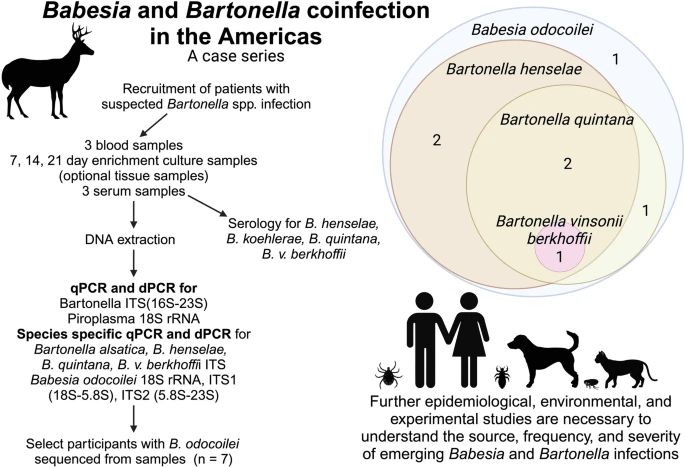
Human Babesia odocoilei and Bartonella spp. co-infections in the Americas

Maggi, Ricardo G.; Calchi, Ana Cláudia; Moore, Charlotte O.; Kingston, Emily; Breitschwerdt, Edward B.

Abstract​

Background​

In recent years, Babesia and Bartonella species co-infections in patients with chronic, nonspecific illnesses have continued to challenge and change the collective medical understanding of “individual pathogen” vector-borne infectious disease dynamics, pathogenesis and epidemiology. The objective of this case series is to provide additional molecular documentation of Babesia odocoileiinfection in humans in the Americas and to emphasize the potential for co-infection with a Bartonella species.

Methods​

The development of improved and more sensitive molecular diagnostic techniques, as confirmatory methods to assess active infection, has provided increasing clarity to the healthcare community.

Results​

Using a combination of different molecular diagnostic approaches, infection with Babesia odocoilei was confirmed in seven people suffering chronic non-specific symptoms, of whom six were co-infected with one or more Bartonella species.

Conclusions​

We conclude that infection with Babesia odocoilei is more frequent than previously documented and can occur in association with co-infection with Bartonella spp.

Graphical Abstract​

13071_2024_6385_Figa_HTML.png


Web | DOI | PDF | Parasites & Vectors
 
I’m not well enough to read through all this atm. Is there any evidence which suggests that it might be worth people with an ME/CFS diagnosis being tested for babesia and bartonella? Are there effective treatments for those who test positive?
 
“This “study” reports lots of Babesia/Bartonella “positives” in a self-selected fatigue cohort without a control group, using an enrichment-PCR workflow sold by the authors’ own diagnostics company. DNA detection ≠ active infection ≠ causation, and referral bias + a proprietary assay is a recipe for impressive-looking prevalence numbers that don’t generalize. This study is marketing not science.”

From
 
Back
Top Bottom