Dolphin
Senior Member (Voting Rights)
Open Access Article
Babesia and Bartonella Species DNA in Blood and Enrichment Blood Cultures from People with Chronic Fatigue and Concurrent Neurological Symptoms
by
Edward B. Breitschwerdt
*<i></i>,
Ricardo G. Maggi
<i></i>,
Janice C. Bush
<i></i> and
Emily Kingston
<i></i>
Intracellular Pathogens Research Laboratory, Comparative Medicine Institute, College of Veterinary Medicine, North Carolina State University, Raleigh, NC 27607, USA
*
Author to whom correspondence should be addressed.
Pathogens 2026, 15(1), 2; https://doi.org/10.3390/pathogens15010002
Submission received: 12 November 2025 / Revised: 11 December 2025 / Accepted: 17 December 2025 / Published: 19 December 2025
Abstract
Myalgic encephalomyelitis/chronic fatigue syndrome (ME/CFS) is a medical condition characterized by extreme fatigue lasting at least 6 months.Based upon case reports, patients infected with Babesia or Bartonella spp. have reported a history of chronic fatigue and concurrent neurological symptoms.
In this study, 50 study participants reporting fatigue lasting from six months to 19 years and one or more neurological symptoms were selected. PCR assays were used to amplify Babesia and Bartonella spp.
DNA from blood and enrichment blood cultures.
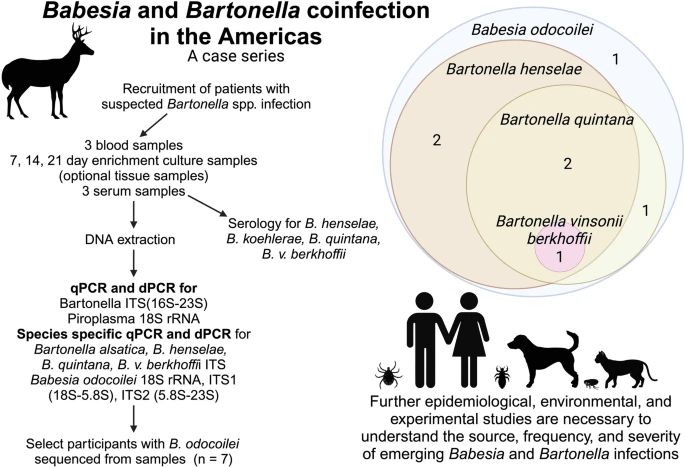
Using targeted qPCR amplification and DNA sequencing, infection with Babesia spp., Bartonella spp. or both genera was confirmed in 10, 11, and 2 individuals, respectively.
Of 50 participants, 12 (24%, 95% CI: 12–36%) were infected with a Babesia species, while Bartonella species infection was documented in 13/50 individuals (26%, 95% CI: 13.8–38.2%).
This study provides documentation supporting a potential role for Babesia and Bartonella infection in patients with presentations consistent with ME/CFS.
Prospective case–control studies, using highly sensitive direct pathogen detection techniques, are needed to determine whether or the extent to which infection with members of these two genera contributes to or causes ME/CFS.
Keywords:
Bartonella; Babesia; flea; tick; vector; infection; PCR; enrichment culture