Age at onset of narcolepsy in two large populations of patients in France and Quebec, 2001, Dauvilliers et al.

ScoutB

Senior Member (Voting Rights)
Age at onset of narcolepsy in two large populations of patients in France and Quebec
Authors: Y Dauvilliers, J Montplaisir, N Molinari, B Carlander, B Ondze, A Besset, M Billiard

Abstract

Background
Narcolepsy usually starts around adolescence; however, there is great variability in the clinical presentation of narcolepsy.

Objective
To determine the age at onset in conjunction with severity of narcoleptic symptoms in two large populations of narcoleptic patients with a similar genetic background.

Methods
Information on age at onset and severity of the condition was obtained in 317 patients with well-defined narcolepsy-cataplexy from Montpellier (France) and in 202 from Montreal (Canada).

Results
The mean age at onset was 23.4 years in Montpellier and 24.4 in Montreal. The age at onset was bimodal in two independent patient populations: a first peak occurring at 14.7 years, and a second peak occurring at 35. Age at onset clearly differentiates patients with a positive family history of narcolepsy (early onset) from those without a family history. Other clinical and polygraphic findings may indicate that young age at onset is associated with increased severity of the condition (higher frequency of cataplexy and decreased mean sleep latency on the Multiple Sleep Latency Test).

Conclusion
Bimodal distribution of age at onset of narcolepsy was found in two independent patient populations. Our data suggest that age at onset is genetically determined.

(Note this study is from 2001)
Web | DOI | Sci-hub | Neurology | Paywalled
 
Last edited:
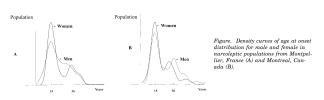
After reading a couple of recent threads on narcolepsy (eg. @jnmaciuch's here), I was curious about the age distribution of onset and found this study (which I don't think has been posted before?).

It's intriguing that they found a dual peak situation similar to what others have suggested exists in ME/CFS. I've only skimmed the paper so far and don't know much about this kind of epidemiology, so am curious what others think. @Jonathan Edwards I know you've been interested in both an ME/CFS-narcolepsy connection, and the age of onset data so I'd be interested in what you make of this.
 
When narcolepsy was fund to be associated with HLA-DQ (as ME/CFS probably is, but in an obscure and much more limited way) we settled in to the idea that it was an autoimmune disease like a lot of others - tick box, job done.

But two age peaks throws up major questions about how that would fit. And the autoimmune story always seemed a bit atypical and incomplete for narcolepsy.

I can't help thinking all this is telling us something important.
 
I can't help thinking all this is telling us something important.

Just a thought, but

A persistent whiff of cholesterol.

Global lipid metabolism must be changing in association with newly active steroid hormones in adolescence. Is it going through an onset and offset phase as things ramp up, peak in early adulthood and then presumably ramp down afterwards? Could those two "ramp" periods be vulnerable?
 
Last edited:
When narcolepsy was fund to be associated with HLA-DQ (as ME/CFS probably is, but in an obscure and much more limited way) we settled in to the idea that it was an autoimmune disease like a lot of others - tick box, job done.

But two age peaks throws up major questions about how that would fit. And the autoimmune story always seemed a bit atypical and incomplete for narcolepsy.

I can't help thinking all this is telling us something important.
Just my gut from watching peers but mid-teens is whe long lie ins tend to be needed more by more (there are always some larks) and 35yrs sounds in the middle of the time when people stopped wanting to stay up late apart from exceptions even when they didn’t have kids
Just a thought, but


Global lipid metabolism must be changing in association with newly active steroid hormones in adolescence. Is it going through an onset and offset phase as things ramp up, peak in early adulthood and then presumably ramp down afterwards? Could those two "ramp" periods be vulnerable?
related to me/cfs rather than narcolepsy but I had a significant growth spurt (6-7inches in 6months and went from being shortest in year to taller than many of my friends - what is more unusual is I'd assumed that short height was my height and I've still very small hands and not quite just like a stretched version of that old body but it was mainly growing height-wise) a year or two before being ill that I also get reminded of by those who knew me and are interested in that way. Of course I think I was also eating a lot more meat around that time as well (and jokes about it probably being the hormones in that causing the growth spurt etc).

It feels like my need for sleep was most affected but unfortunately compared to my peers I didn't really get the chance for lie-ins (very much not a lark) despite very much craving them and had a lot on my plate, had to do catch-up sleeps on Sundays when I could etc.

But looking it up the growth-hormone side of things doesn't seem to have that second peak. And how 'peaky' is the peak for both?

I looked up pregnancy (as there is anecdotes about me/cfs and pregnancy, narcolepsy doesn't seem to show a pattern of some feeling better but I'm guessing it is complicated by lots also stopping medications) and growth-hormone out of interest and see that one is an interesting answer as the placental version supresses the pituitary version apparently.

I've witnessed the same thing in others 35yrs onwards where even without kids the wanting to go out late becomes for rarer events, even after more were home-working (no commute) and more don't want to even speak on the phone after what would seem a very early time but it is hard to separate from their jobs situation and 'other things' including doing different stuff with their weekends as lots then seem to have taken up new hobbies, mixed versions of claims of 'wanting to be healthier'.

I notice those who don't want to do later evening stuff but I'm not sure they are all replacing that with/driven by getting up early ie is it a shift or a shrink or even a shrink in what they have spare beyond expanding work committments and their social opportunities they are offered now being early or day-based due to others etc.

I do think that the world being what it is those who are larks have more opportunities for 'adjustments', increasingly so as they get older even if it is as simple as an employer being happy with whatever hours isn't reserving parking spots so those asking for early times park near the door where after 9am it is struggle to park a mile away, and repeat if it's street/shared parking at home. There might be some humour in a person in their 20s coming in late as 'being rubbish/young/social' is often understood better than illness, but I get the impression being near 40, 50yrs and not functioning until 10am+ just has some innate different filter from outsiders (as you haven't 'grown out of it').

And so more minor issues have the difference of being copable 'situations' or not. And the realisation as you stand out more like a sore thumb vs peers who also think they get tired too etc over time means it would be useful to know 'when it started' as well as actual diagnosis.

I'd guess there might be certain versions of narcolepsy that are not such long journeys to diagnosis due to the symptoms not just being fatigue or sleepiness but more distinctive features others would agree need to be looked into (particularly if there are medications for it)? Of course comparing that age incidence with another 'type' can't be assumed to be due to time to diagnosis/culture and not type differences but it would be interesting.
 
Back
Top Bottom